
How to play
New here? This is the short version. You learn the rest by flying.
The goal
Grow the most successful airline in your world. Open profitable routes, run a healthy fleet, keep your finances strong, and out-compete rival carriers — human and AI — before the world ends.
The menu
In a world the menu runs down the left side of the screen; on a phone it is the bar along the bottom. Each icon opens one page:
| Menu | What it is for | |
|---|---|---|
| 🏢 | Home | Your company at a glance: cash, earnings and what needs you |
| 🌎 | Map | Your routes and airports on the map |
| 🛬 | Airports | Find airports: runways, demand and your slots |
 |
Flights | Every route: change fares and frequencies, open new ones |
| 🤝 | Slots | Send a rep to an airport to win slots |
| ✈ | Fleet | Your aircraft and the routes they fly |
| 🏭 | Store | Order new aircraft from the makers |
| 🏷️ | Used | Lease or buy used aircraft, ready at once |
| ⚙ | Ops | Company-wide settings: service level, advertising |
| 🏆 | Ranking | Your market share against your rivals |
| 📊 | History | Revenue, costs and cash, round by round |
Your first game
- Found your airline. Pick a name, a short code, an era and a base airport. The era sets the year, the aircraft on sale and the rivals you meet.
- See what you start with. Cash, one leased aircraft, and slots at your base and at two airports nearby. That is enough for your first routes.
- Open a route. On the Flights page, open a route from your base to one of those two airports. Keep the suggested fare for now.
- Put your aircraft on it. Assign the aircraft to the route and choose how many flights a week. One aircraft can fly several routes if it has hours to spare.
- Let the round settle. Nothing flies until the round ends. Then the dashboard shows how many passengers the route carried and what it earned.
- Grow. Send a rep for slots at a new airport, order another aircraft, open the next route. Each of these takes a few rounds, so start before you need them.
Every page in the game has a blue ? beside its title. It explains that page: what the numbers mean and what each button does.
Rounds
The game moves in rounds, and one round is one week of flying. You can give orders at any time. They take effect when the round settles: routes open, fares change, slots and aircraft arrive, and the money is counted.
Every world runs on a clock, shown at the top of the screen. In a solo world the clock is yours: pause it while you think, or tap ⏱ to skip the wait. Every solo world holds up to 24 free skips, and one comes back every 30 minutes whether you are playing or not; with none left, a skip costs Jet Coins. In a multiplayer world everyone shares one clock and the whole world settles together, whether you are online or not.
The top bar
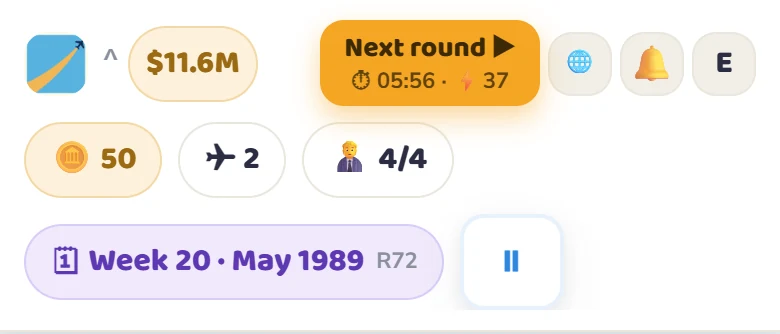
At the top of every page in a world sits a bar with your airline's numbers. Most of them are buttons: tap one to go to the page behind it.

- Logo and name: your airline.
- 💰 Cash: the money in the bank. Tap it for the Financial history.
- ✈ Fleet: how many aircraft you have. Tap it for your fleet.
- 🧑💼 Slot reps: reps free now / reps in all. A rep wins slots at an airport; tap it for Slots.
- 🪙 Jet Coins: your coin balance. Tap it to get more.
- 🗓 Date: the week, month and year in the game, and the round number (R). Tap it for the Timeline.
- ⏸ Pause (solo worlds only): stops the clock while you think. ▶ starts it again.
- Next round ▶: settles the round now. ⏱ is the time left before it settles by itself, and ⚡ the free skips you have left. In a multiplayer world the shared clock sits here instead.
- 🌐 language, 🔔 notifications, and your initial, which opens My games, Achievements, Account settings and Log out.
On a phone the bar keeps only your cash, Next round and the three buttons on the right. Tap the logo, with the small arrow beside it, to open the rest:
🤝 Slots
A slot is the right to run one flight a week at an airport, and a route needs slots at both ends. Slots are what limits a young airline, more often than money.
- To get slots at a new airport, send one of your reps from the Slots page. The rep is away for a few rounds and comes back with an answer.
- Ask for a few at a time. A small request is quicker and granted more often, and you can go back for more.
- A request can be refused, or a rival can take the last slots. The rep is free again: ask for fewer, or try another airport.
- Every airport has a fixed number of slots, shared by all airlines. A busy airport can be full.
- You start with two reps and gain more as your network grows.
✈ Aircraft
- New jets come from the factory. You may order as many as you can pay for, but each one has to be built: it arrives some rounds later, and several arrive one after another.
- The used market sells single older aircraft. They are cheaper and join your fleet the next round, but they cost more to maintain.
- Buy or lease. Buying takes a deposit now and the rest when the aircraft arrives; it is yours and counts toward your net worth. Leasing takes far less cash, but you pay rent every round and the aircraft never adds to your net worth.
- Deliveries lists what you have ordered and the round each one arrives. An aircraft on order cannot fly yet.
- Check range, runway and seats before you order. An aircraft cannot use an airport whose runway is too short for it.
- An aircraft without a route earns nothing and still costs money every round.
Routes that earn
- Demand depends on the size of the two cities, the distance and the fare. Rivals on the same route split the passengers.
- Load is the share of seats you filled. Full and profitable: raise the fare or add flights. Half empty: lower the fare or cut flights.
- Reputation grows with service and advertising, both set on the Operations page, and wins you a larger share of each market over time.
- A route that still loses money after a few rounds of changes should be closed. Your slots stay yours.
🛬 Hubs and international routes
Flying abroad needs a hub. Once you run enough routes from an airport in your home country, you can build a hub there for cash. It unlocks international routes from that airport and speeds up slot negotiations there. In worlds that span several countries, such as Europe or Southeast Asia, flights inside the region need no hub; only flights that leave it do.
📦 Charter contracts
In solo worlds, other companies sometimes hire your spare capacity. Offers appear on the dashboard under Needs you.
- Series charter. A tour operator or festival books one of your jets for 1–4 round trips a week between two airports, for 4 to 26 weeks. Every seat is sold, the pay per flight is fixed, and no slots or hub are needed. It comes when a jet has flown under half its week for 4 weeks in a row. While it runs the jet can't be sold or returned; ending early costs 2 weeks of pay. Afterwards a scheduled route on the same pair, opened within 26 weeks, starts with much stronger demand.
- Whole-aircraft lease. From your second year, with at least 5 jets, an airline or government may hire a whole jet with crew for 1 to 3 years and pay a fixed fee every week. Only an idle jet of the size asked for can go, and you have 4 weeks to send one: free a jet by moving its flights to others, or lease a used one; a new jet takes too long to build. Once sent it is marked "Leaves next week" and can't be sold, scheduled or re-seated until it comes back. Leaving early costs 13 weeks of the contract's profit.
- Nothing comes in your first 20 weeks. Declining an offer costs nothing.
📊 Money matters
- Every route earns or loses money each turn; airline-wide costs (bases, hubs, service, advertising) come off the top.
- Leasing spreads cost; buying is cheaper long-term. Loans give you room to grow but charge interest every turn.
- Prices are modelled in real terms and adjusted for inflation across eras, so watch your margins.
- Run out of cash and you risk bankruptcy — but not on the spot. Going negative starts a countdown of a few rounds, shown on screen; climb back into the black before it runs out and the clock resets. Sell an aircraft, close a route that is losing money, or borrow.
- Watch what you have already promised. Buying an aircraft pays part up front and the balance on delivery, charged whatever your cash happens to be that round. The Fleet page totals what your order book still owes.
Jet Coins
Jet Coins are an account-wide currency. They save time and add convenience — hiring extra agents, rushing a slot negotiation, speeding up an aircraft delivery, or fast-forwarding the clock. They never buy an unfair advantage: every airline plays by the same rules.
You can get Jet Coins three ways: earn them by playing, buy them if you'd like a top-up, or receive them from events and giveaways. Airline Legend is free to play — buying Jet Coins is always optional. See your balance on the wallet page.
🏆 Badges and achievements
Solo worlds have goals: a checklist for your first year, then six chapters, then a review every year. Goals pay bonus skips, and some badges pay Jet Coins. Multiplayer worlds hand out titles when they end. Badges and achievements lists all 18 badges, what each one takes and what it pays.
When a world ends
A multiplayer world runs to its last round and then settles for good. Every airline is ranked by net worth — yours, everyone else's, and the AI carriers — and that order is frozen into a final report you keep after the world itself is gone.
Placement. The top three human airlines split a pool of Jet Coins, 50% / 30% / 20%. The pool grows with the world: 20 Jet Coins for every human airline that actually operated, so a full world is worth more than a quiet one.
Awards. Two more titles are handed out, each worth a flat 100 Jet Coins to the best human airline in that category:
- Largest network — most airports served at your peak.
- Most passengers — most people carried across the whole world.
They stack with placement. Winning the world and flying the most passengers is two prizes, because it was two achievements. An AI can hold a title, but it has no wallet, so no Jet Coins go to it.
The four-player minimum. A world pays nothing at all unless at least four human airlines actually operated in it — flew a route, for at least one round. Below that the payout is zero rather than a smaller share, which is what keeps prizes out of reach of a world filled with empty seats. Solo worlds pay no prizes; their Jet Coins come from goals and badges (see Badges and achievements).
Prizes are Jet Coins and titles only. They never buy an in-world advantage, so nobody wins next season for having won last one.
The leaderboard. The career board ranks players on the prize Jet Coins that finished worlds have actually paid them — never on wallet balance, so bought Jet Coins cannot buy a place on it. Your finished games and their reports live on your career page.
Reminders on your phone
A world you have joined can tell you when it is about to start. The offer appears on the world's card, under the start time, and it is the only place we ask — if you say no, nothing asks again.
Four messages, and no others: the world is about to start, your airline is close to running out of money, your airline has been wound up, and the world has ended. Turning them off, or removing a device, is on your account page.
On iPhone and iPad reminders only work from a home-screen icon, because Safari cannot send them to a browser tab. Add the game to your home screen first:
- Tap the Share button in Safari's toolbar.
- Scroll down and choose Add to Home Screen.
- Open the game from the new icon, then ask for reminders again.
There is still nothing to download and no app store involved — the icon opens the same site.
Tips
- Start small and profitable before you expand.
- Don't over-order capacity on a thin route.
- Keep some cash for maintenance and slow seasons.
- Watch what the AI airlines do — the market reacts to everyone.
Still stuck? Use the Contact us page and we'll help.